



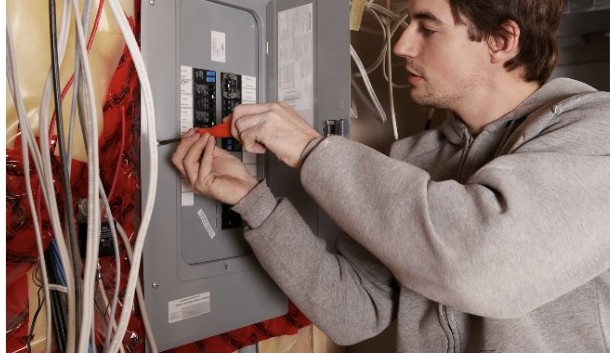
Your home’s electrical panel needs replacement when it is over 25 years old, uses a brand with documented safety defects, cannot support the home’s current electrical load, or shows physical signs of heat damage, corrosion, or moisture intrusion.
The electrical panel is the central distribution point for every circuit in a home. A panel that cannot perform that function safely and reliably creates a risk that compounds over time. The National Fire Protection Association reports that electrical distribution and lighting equipment cause approximately 44,900 home fires annually in the United States.
Homeowners in Lakewood who suspect their panel is due for replacement can schedule an evaluation with a Residential Electrical Panel Replacement Lakewood CO specialist who can assess the specific condition and capacity of the existing equipment.
Here is how to evaluate whether your panel has reached the end of its service life.
What Are the Warning Signs of a Failing Electrical Panel?
Breakers That Trip Frequently
A breaker that trips more than once or twice per year on a circuit with a normal load is failing. Breakers have a mechanical service life. After thousands of trip cycles over decades of use, the trip mechanism wears and becomes unreliable.
An unreliable breaker may trip at loads below its rating, causing nuisance interruptions. More dangerously, it may fail to trip at loads above its rating, allowing the circuit to carry more current than its wiring can safely handle.
Breakers That Will Not Reset
A breaker that trips and will not reset, or resets and immediately trips again, indicates either an active fault on the circuit or a breaker that has failed mechanically. Attempting to force a breaker to hold in the on position by repeatedly resetting it is not a solution. It bypasses the protection the breaker provides.
A Burning Smell from the Panel
A burning or hot plastic smell from the panel is a serious warning sign. It indicates that a component inside the panel is overheating. Heat damage inside a panel produces conditions that can lead to fire.
If you smell burning from your electrical panel, turn off the main breaker and call an electrician immediately. Do not wait to see if the smell resolves on its own.
Physical Signs of Heat or Moisture
Open the panel door and look at the inside surface of the enclosure, the breakers, and the wiring.
Signs that require immediate professional evaluation include:
- Discoloration or scorch marks on the panel interior
- Corrosion on breaker bodies or bus bars
- Moisture or rust inside the enclosure
- Melted wire insulation on any conductor
Any of these conditions indicates that the panel has experienced a stress event that has compromised its components.
What Panel Brands Have Known Safety Issues?
Federal Pacific Electric (FPE) Stab-Lok panels are among the most documented problem products in residential electrical history. These panels, common in homes built between 1950 and 1990, use Stab-Lok breakers that have been shown in testing and field investigations to fail to trip under fault conditions at a higher rate than code-compliant breakers.
If your panel has a red-lettered Stab-Lok label or a Federal Pacific nameplate, have it evaluated by a licensed electrician and consider replacement regardless of the panel’s apparent condition.
Zinsco panels, also called GTE-Sylvania, were common in homes built during the 1970s. Zinsco breakers have been documented to bond to the aluminum bus bar inside the panel over time, preventing them from tripping when a fault occurs. Breakers that cannot trip under fault conditions are not functioning as protective devices.
When Is 100-Amp Service No Longer Adequate?
A 100-amp service panel was adequate for homes without central air conditioning, electric dryers, or electric ranges. Most homes today have at least two of those three and may also have EV charging loads.
The calculation is straightforward: add up the amperage of the major loads in the home. An electric range draws 40 to 50 amps. A central air conditioner draws 20 to 40 amps. An electric dryer draws 30 amps. An EV Level 2 charger draws 40 to 50 amps. These four items alone can total 130 to 170 amps, exceeding the capacity of a 100-amp panel.
The symptom of an undersized panel is breakers tripping when multiple large appliances run simultaneously. The solution is a service upgrade, typically to 200 amps for a residential installation or 400 amps for homes with multiple EVs or whole-home electrification.
What Does Panel Replacement Involve?
Panel replacement is a permit-required project in every jurisdiction. The process includes:
- Shutting off the main service entrance from the utility
- Removing the existing panel and disconnecting all branch circuit wiring
- Installing the new panel and reconnecting all circuits
- Coordinating with the utility to restore service after inspection
Most panel replacements take one to two days for a residential installation. The home is without power during the replacement, which is planned in advance.
The permit triggers an inspection by the local authority having jurisdiction. That inspection verifies that the new panel is correctly sized, properly grounded, and that all connections meet current code. Passing the electrical inspection provides documentation that protects the homeowner at resale.
Conclusion
An electrical panel that is over 25 years old, carries a problem brand name, cannot support the home’s electrical load, or shows physical signs of heat or moisture damage is a panel that needs professional evaluation and likely replacement.
The panel is the foundation of every electrical system in the home. A foundation that is compromised creates risk that grows over time rather than stabilizing. Addressing it proactively, before a failure forces the decision during an emergency, is the responsible and financially sound choice.