


Introduction
Securing funding is one of the biggest challenges entrepreneurs face when building a startup. While a great idea and a strong team are essential, turning a vision into a successful business often requires financial resources. Startup funding provides the capital needed to develop products, hire talented employees, expand marketing efforts, and enter new markets.
However, raising money is about much more than convincing investors to write a check. Founders must understand the different funding options, prepare a compelling business case, and choose a financing strategy that aligns with their long-term goals.
This guide explains how startups can navigate funding successfully while building a sustainable foundation for future growth.
Understanding Startup Funding
Startup funding refers to the financial resources used to launch, operate, and grow a new business. Depending on the company’s stage and objectives, funding can come from personal savings, customers, investors, financial institutions, or government programs.
Choosing the right funding source depends on factors such as business model, revenue potential, industry, and growth plans.
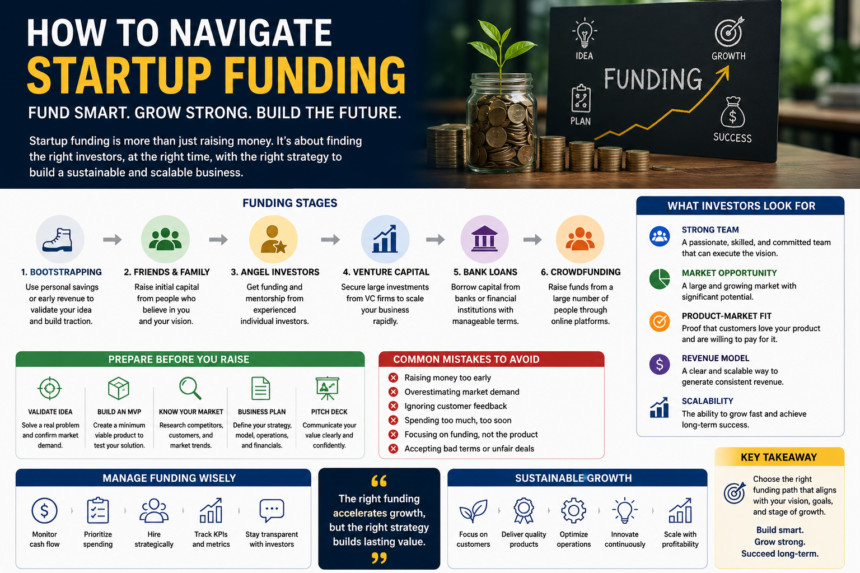
Common Funding Stages
Bootstrapping
Many entrepreneurs begin by investing their own savings or using revenue generated by early customers. Bootstrapping allows founders to maintain full ownership while validating their product.
Friends and Family
Some startups receive early financial support from trusted family members or friends who believe in the founder’s vision.
Angel Investors
Angel investors provide capital during the early stages in exchange for equity. They often contribute valuable experience and business connections.
Venture Capital
Venture capital firms invest in startups with strong growth potential. In addition to funding, they may offer strategic guidance, industry expertise, and networking opportunities.
Bank Loans
Established startups with predictable cash flow may qualify for business loans that provide capital without giving up ownership.
Crowdfunding
Crowdfunding platforms allow entrepreneurs to raise money from a large number of supporters who believe in their product or mission.
Preparing Before Raising Capital
Before approaching investors, founders should prepare thoroughly.
Validate Your Idea
Demonstrate that your product solves a real customer problem and has market demand.
Build a Minimum Viable Product (MVP)
An MVP allows customers and investors to see your solution in action.
Understand Your Market
Research competitors, customer needs, industry trends, and market size.
Create a Business Plan
A detailed business plan should explain your product, revenue model, target audience, marketing strategy, and financial projections.
Develop a Strong Pitch Deck
Your presentation should clearly explain:
- The problem
- Your solution
- Market opportunity
- Business model
- Competitive advantage
- Team
- Financial forecasts
- Funding requirements
What Investors Look For
Investors evaluate startups based on several important factors.
Strong Founding Team
Experienced, motivated, and adaptable founders inspire confidence.
Large Market Opportunity
Investors prefer businesses operating in expanding markets.
Product-Market Fit
Evidence that customers genuinely need and value the product is essential.
Revenue Potential
Clear monetization strategies improve investment opportunities.
Scalability
Businesses capable of growing efficiently are often more attractive.
Common Mistakes to Avoid
Many startups struggle because they:
- Raise money too early.
- Overestimate market demand.
- Ignore customer feedback.
- Spend excessively after funding.
- Focus on fundraising instead of building the product.
- Accept unfavorable investment terms.
Avoiding these mistakes improves long-term success.
Managing Funding Wisely
Raising capital is only the beginning. Successful founders manage resources carefully by:
- Monitoring cash flow.
- Prioritizing essential spending.
- Hiring strategically.
- Measuring key performance indicators (KPIs).
- Investing in customer acquisition responsibly.
- Maintaining financial transparency.
Smart financial management increases investor confidence and business stability.
Building Sustainable Growth
Funding should support sustainable growth rather than rapid expansion without direction. Companies that focus on customer satisfaction, product quality, operational efficiency, and continuous innovation are better positioned for long-term success.
Founders should balance ambitious growth goals with careful financial planning to avoid unnecessary risk.
Conclusion
Navigating startup funding is a journey that requires preparation, patience, and strategic decision-making. Whether you bootstrap your business, work with angel investors, secure venture capital, or combine multiple funding sources, the goal should always be to build a healthy and sustainable company.
By validating your idea, understanding investor expectations, managing capital responsibly, and staying focused on solving real customer problems, you can increase your chances of building a startup that not only attracts funding but also achieves lasting success in today’s competitive business landscape.