



Introduction
A County Integrated Development Plan (CIDP) is a strategic planning document that outlines a county government’s long-term development priorities, goals, and projects. It serves as a roadmap for economic growth, infrastructure development, public service delivery, and social progress over a specific planning period. By aligning local development initiatives with national policies and community needs, a County Integrated Development Plan helps ensure that resources are used efficiently and development benefits all citizens.
The CIDP is an essential tool for counties seeking sustainable development, improved governance, and better accountability. It provides a clear vision for the future while guiding investment decisions and public spending.
What Is a County Integrated Development Plan?
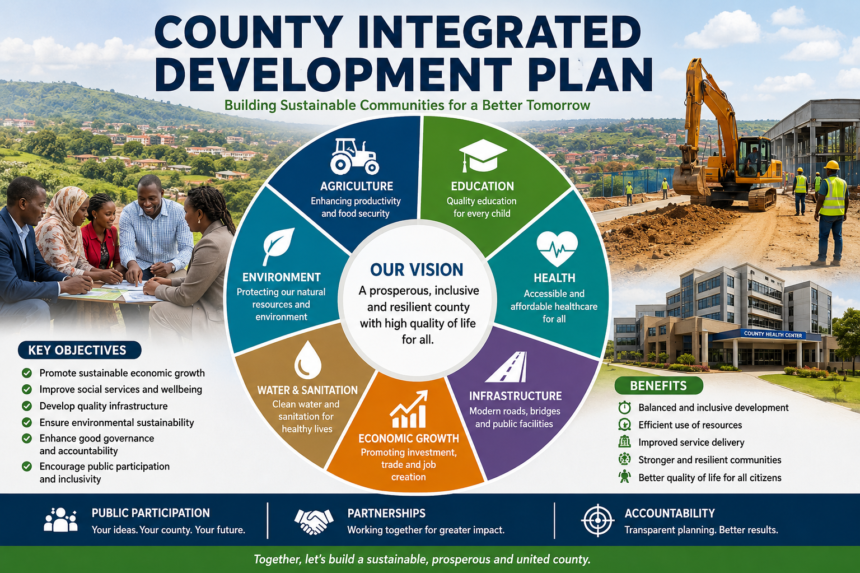
A County Integrated Development Plan is a comprehensive document that identifies a county’s development objectives, available resources, implementation strategies, and expected outcomes. It integrates various sectors such as agriculture, education, healthcare, infrastructure, water, environmental conservation, trade, and technology into one coordinated development framework.
The plan usually covers a five-year period and is reviewed regularly to reflect changing priorities and emerging challenges.
Importance of a County Integrated Development Plan
A well-prepared County Integrated Development Plan offers several benefits for both local governments and citizens.
First, it provides a clear direction for development by setting measurable goals and identifying priority projects. Second, it improves transparency by allowing citizens to understand how public funds will be spent. Third, it encourages community participation, ensuring that development projects reflect the actual needs of local residents.
Additionally, the CIDP strengthens coordination between government agencies, private investors, non-governmental organizations, and development partners.
Key Objectives of a CIDP
The primary goal of a County Integrated Development Plan is to improve the quality of life for residents through sustainable development. Common objectives include:
- Promoting economic growth and job creation
- Improving healthcare and education services
- Expanding transportation and public infrastructure
- Supporting agriculture and food security
- Protecting natural resources and the environment
- Enhancing governance and public participation
- Increasing access to clean water and sanitation
- Encouraging investment and business development
These objectives help counties achieve balanced and inclusive development.
Main Components of a County Integrated Development Plan
A typical County Integrated Development Plan contains several important sections.
Situation Analysis
This section provides an overview of the county’s population, economy, natural resources, infrastructure, education, health services, and environmental conditions. It identifies existing challenges and development opportunities.
Development Priorities
Based on the analysis, the county identifies sectors requiring immediate attention. Priority projects are selected according to available resources and expected impact.
Strategic Goals
The plan establishes clear, measurable goals that guide county development throughout the planning period.
Budget and Resource Allocation
Financial planning is an essential part of the CIDP. It outlines estimated project costs, funding sources, and budget priorities.
Monitoring and Evaluation
To ensure successful implementation, the plan includes performance indicators and regular evaluation processes that measure progress and identify areas requiring improvement.
Community Participation in Development Planning
Public participation is one of the most important principles of a County Integrated Development Plan. Citizens are encouraged to share ideas, identify local challenges, and propose development priorities through public meetings, surveys, and stakeholder consultations.
This participatory approach increases transparency, accountability, and public trust while ensuring that development projects meet community needs.
Challenges in Implementing County Integrated Development Plans
Although the CIDP provides a strong framework for development, implementation often faces several challenges.
Limited financial resources may delay important projects. Political changes can affect development priorities, while inadequate technical expertise may slow project execution. In some cases, weak monitoring systems and limited public participation reduce overall effectiveness.
Addressing these challenges requires good governance, proper planning, sufficient funding, and continuous collaboration among stakeholders.
Future of County Integrated Development Planning
Modern technology is transforming how counties prepare and implement development plans. Geographic Information Systems (GIS), digital data collection, online public consultations, and performance monitoring tools help governments make better planning decisions.
Climate change adaptation, renewable energy, smart infrastructure, digital services, and sustainable urban development are becoming increasingly important components of future County Integrated Development Plans.
As counties continue adopting innovative planning approaches, CIDPs will play an even greater role in achieving long-term economic growth and sustainable development.
Conclusion
A County Integrated Development Plan is much more than a planning document. It is a strategic roadmap that guides counties toward sustainable economic growth, improved public services, and better governance. Through careful planning, community participation, transparent budgeting, and effective implementation, the CIDP helps create stronger, more resilient communities.
As local governments continue facing new development challenges, a well-designed County Integrated Development Plan remains one of the most effective tools for achieving inclusive growth and improving the lives of citizens.