



Introduction
Quantum computing made remarkable progress in 2024, bringing the technology closer to practical real-world applications. While traditional computers process information using bits that are either 0 or 1, quantum computers use quantum bits, or qubits, which can exist in multiple states at the same time. This unique capability allows quantum systems to solve certain complex problems much faster than classical computers.
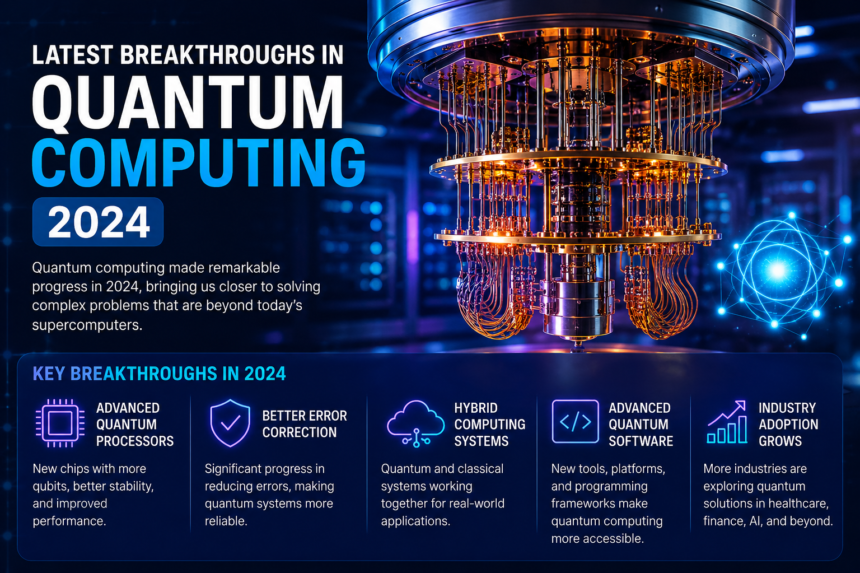
The year 2024 witnessed several important breakthroughs in hardware, software, error correction, and commercial adoption. These developments are shaping the future of industries such as healthcare, cybersecurity, finance, logistics, and artificial intelligence.
Why Quantum Computing Matters
Modern computers are incredibly powerful, but they struggle with problems that involve massive amounts of data or complicated calculations. Quantum computers are designed to tackle these challenges more efficiently by taking advantage of quantum mechanics.
Although quantum computing is still in its early stages, every major breakthrough brings researchers closer to building reliable, large-scale quantum machines capable of solving problems that are currently impossible.
Major Quantum Computing Breakthroughs in 2024
Improved Error Correction
One of the biggest obstacles in quantum computing has been reducing errors caused by unstable qubits. During 2024, researchers achieved significant improvements in quantum error correction techniques.
These advances make quantum computers more reliable and increase the amount of time qubits can perform calculations before losing information. Better error correction is considered one of the most important milestones toward practical quantum computing.
More Powerful Quantum Processors
Technology companies introduced new quantum processors with higher qubit counts and better overall performance. Instead of focusing only on increasing the number of qubits, developers also improved qubit quality, connectivity, and stability.
This balanced approach allows quantum processors to perform increasingly complex tasks while maintaining greater accuracy.
Hybrid Computing Systems
Another major trend in 2024 was the rise of hybrid computing. In these systems, classical computers and quantum computers work together.
Traditional computers handle everyday processing tasks, while quantum processors solve highly specialized mathematical problems. This combination provides practical benefits without requiring organizations to replace existing computing infrastructure.
Better Quantum Software
Software development also advanced rapidly during 2024. New programming tools, software development kits, and cloud-based quantum platforms made quantum computing more accessible to researchers, developers, and students.
Improved software allows users to design quantum algorithms more efficiently while reducing programming complexity.
Industries Benefiting from Quantum Computing
Healthcare and Drug Discovery
Quantum computing has the potential to transform medical research by simulating complex molecular interactions much faster than classical computers.
Researchers believe future quantum systems could accelerate drug discovery, improve personalized medicine, and help scientists understand diseases at a deeper level.
Financial Services
Banks and investment firms are exploring quantum computing for portfolio optimization, fraud detection, financial modeling, and risk analysis.
Quantum algorithms may eventually perform calculations that currently require enormous computing resources, helping financial institutions make faster and more informed decisions.
Artificial Intelligence
Artificial intelligence and quantum computing are becoming increasingly connected.
Researchers are studying how quantum algorithms can improve machine learning, optimize neural networks, and process massive datasets more efficiently. While practical quantum AI is still developing, 2024 showed promising progress in this area.
Cybersecurity
Quantum computing presents both opportunities and challenges for cybersecurity.
Future quantum computers could break some existing encryption methods. As a result, governments and technology companies are actively developing quantum-resistant cryptography to protect sensitive digital information against future threats.
Challenges That Still Remain
Despite impressive progress, quantum computing is not yet ready to replace traditional computers.
Several challenges continue to slow widespread adoption:
- High development costs
- Difficult operating conditions requiring extremely low temperatures
- Limited availability of stable qubits
- Complex programming requirements
- Ongoing need for better error correction
Researchers worldwide continue working to solve these issues, and every year brings meaningful improvements.
The Future of Quantum Computing
Experts believe the next decade will be critical for quantum technology. Continued investment from governments, universities, and private companies is accelerating research at an unprecedented pace.
Future quantum computers may help solve global problems involving climate modeling, energy optimization, advanced materials, pharmaceutical research, and scientific simulations that exceed the capabilities of today’s supercomputers.
Cloud-based quantum services are also making the technology available to more developers and researchers, encouraging innovation across industries.
Conclusion
The latest breakthroughs in quantum computing during 2024 demonstrate that the technology is steadily moving from scientific research toward practical applications. Improvements in quantum processors, error correction, software, hybrid computing, and commercial adoption represent significant milestones for the industry.
Although important technical challenges remain, quantum computing continues to evolve rapidly. As research advances and hardware becomes more reliable, quantum technology is expected to reshape healthcare, finance, cybersecurity, artificial intelligence, and many other sectors in the coming years.
For businesses, researchers, and technology enthusiasts, keeping up with the latest quantum computing breakthroughs is essential, as this revolutionary field has the potential to redefine the future of computing itself.