



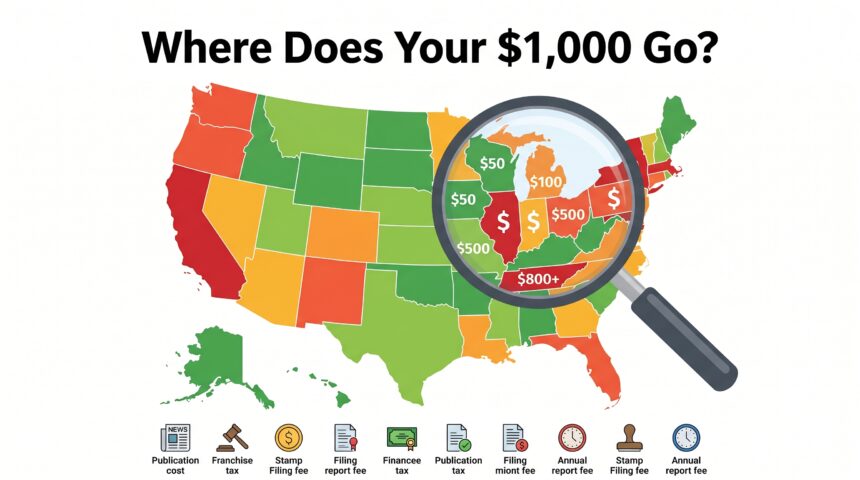
Many new business owners assume that setting aside $1,000 covers everything. That assumption is often wrong. The real LLC formation cost breakdown looks very different once you dig into state requirements. One state asks for $50. Another demands over $800 before you can even open a bank account for your company. A proper breakdown of LLC filing fees by state shows that the cheapest option on paper can become the most expensive over time. This article walks you through a clear state‑by‑state chart. You will see exactly where your money goes. You will also learn whether the cheapest state to register an LLC actually saves you money or quietly costs you more through hidden annual taxes and surprise fees.
1. Let’s clear this up: What does “business registration fees” actually include?
When people ask what business registration fees include, they expect a single number. Reality is messier. A standard LLC registration typically covers:
- Articles of organization filing fee
- Certificate of formation
- Name reservation charge (in some states)
But many states add layers you did not plan for. You might see a separate fee for registering a trade name. Or a filing agent designation. Or a mandatory publication requirement that can cost hundreds of dollars. Some states also bundle the first‑year annual report fee into your initial payment. That is convenient but rarely explained upfront.
So what business registration fees include varies widely. Before you pay, ask for an itemized breakdown from the state’s official website. Do not rely on third‑party summaries. That small habit saves you from surprises and helps you compare apples to apples when deciding where to form your company.
2. The shocking truth: Your $1,000 rarely goes to just one fee
A proper business registration costs breakdown shows that your thousand dollars often gets split four or five different ways. The state filing office takes a large cut. Then there is the registered agent fee if you use a service. Some states charge a separate processing or expediting fee even for standard turnaround times. Local city or county business license fees are not always included in the state total. Publishing requirements in a handful of states add another few hundred dollars.
A real business registration costs breakdown reveals that a $500 state fee can turn into $1,000 or more after mandatory add‑ons. The chart in this article gives you that full picture. Knowing where each dollar lands lets you plan smarter. Some fees are negotiable by choosing different service providers. Others are fixed by law. Do not just look at the headline number. Dig into the breakdown.
3. State-by-state comparison: Where your money really lands
This state chart organizes every state’s fees side by side. An LLC filing fees comparison by state is not just about initial paperwork. It includes annual report fees, renewal costs, and sometimes franchise taxes that hit you every year.
For example, one state might charge $90 to file and $100 annually. Another charges $500 upfront but only $50 each year after. Running an LLC filing fees comparison by state helps you calculate total cost over three or five years, not just day one.
The chart also flags hidden extras like publication fees or mandatory registered agent requirements. Some states look cheap on the surface but become expensive by year two. Others have a higher barrier to entry but lower long‑term costs. Use the comparison to match your business goals with a state that fits your real budget, not just the advertised price.
4. Is the cheapest state to register an LLC actually your best bet?
Finding the cheapest state to register an LLC feels like a smart win. But it can backfire if you ignore other factors. Several states have very low filing fees yet impose high annual franchise taxes or complex reporting rules.
Consider this: one low‑fee state charges a minimum annual tax that wipes out any upfront savings within two years. Another state has a simple filing process but requires you to publish a legal notice in local newspapers. That publication alone can cost more than the filing itself.
So the cheapest state to register an LLC on paper might also mean slower processing times or limited customer support. That matters when you need documents fast. Before you choose, ask yourself:
- Where do you actually operate?
- Where are your customers?
- Do you need extra legal protections?
Sometimes paying a little more upfront for a state with better privacy laws, faster turnaround, or lower long‑term fees makes more sense than chasing the lowest possible number today.
5. Hidden costs almost nobody talks about (until it’s too late)
Small business hidden registration costs separate a smooth launch from a frustrating surprise. One of the most common is the publication requirement found in a few states, like New York. You must advertise your LLC formation in two newspapers for several weeks. That alone can cost $1,000 or more.
Other hidden costs include:
- Notary fees
- Certified copy charges
- Document shipping costs if you file by mail
- Initial statement of information due within 90 days (with its own separate fee)
Small business hidden registration costs also include local permitting fees that city hall never mentions on the state website. You might need a zoning permit, a home occupation permit, or a health department approval depending on your industry. These are not part of the state registration but are mandatory to operate legally. The best way to avoid them is to call your city clerk and ask for a complete list of local licenses before you submit any state paperwork.
6. Why some states charge $50 and others charge $800+
The highest LLC fees by state are not random. They usually reflect three things:
- How a state funds its business division
- Whether it imposes a franchise or privilege tax
- If it includes extra services in the base fee
One state might charge $50 because its business filing office is fully funded by general tax revenue. Another charges $500 because it runs entirely on filing fees. Looking at the highest LLC fees by state also shows patterns. The most expensive states tend to have publication requirements, mandatory registered agent provisions, or biennial report fees bundled into the initial payment.
California has an $800 minimum franchise tax that hits every LLC regardless of profit. Massachusetts and New York have higher upfront costs plus publication fees. But a high fee does not always mean bad value. Some expensive states offer faster processing, better online systems, and clearer customer support. The key is knowing whether you are paying for actual services or just padding state revenue.
7. A quick reality check: What you get for those fees
Understanding what does LLC filing fee cover helps you decide if a state is overcharging or simply offering more. In most states, the filing fee covers the administrative cost of reviewing your articles, reserving your business name, and issuing a stamped approval document. That is the legal proof that your LLC exists.
But what does LLC filing fee cover beyond that varies. Some states provide:
- A free certificate of good standing
- Digital copies of filings
- Expedited processing at no extra charge
Others include the first year’s annual report fee in your initial payment. A few states even offer free name reservation or a complimentary registered agent listing for the first year. On the flip side, a high fee might not include any extras at all. Always read the state’s fee schedule line by line. If something is not listed, call and ask. You want to know exactly which services are included and which will cost you more later.
8. How to pick the right state without getting blindsided by fine print
A solid state business registration requirements comparison goes well beyond the filing fee. You need to look at:
- Ongoing compliance rules
- Annual report deadlines
- Late fee amounts
- Whether the state requires a physical office
One state might have low fees but demand that you publish a notice in a local newspaper. Another might require you to maintain a registered agent with a street address inside the state (not a PO box). Doing a thorough state business registration requirements comparison also checks if the state imposes a franchise tax on LLCs, how often you must file updates, and what happens if you miss a deadline.
Some states dissolve your LLC after one missed report. Others just charge a late fee and let you fix it. You also want to compare privacy protections. A few states do not publish the names of LLC members. That can be valuable for many owners. Take your time. Read the fine print before you fill out any forms.
9. The bottom line: Save money, but don’t chase cheap blindly
The idea that the cheapest state to register an LLC is not always best becomes very clear once you run a three‑year cost projection. A state with a $100 filing fee but a $300 annual franchise tax costs you $1,000 by year three. Another state with a $500 filing fee and a $50 annual report costs you only $600 over the same period.
So the cheapest state to register an LLC on day one can become the most expensive choice over time. You also need to consider convenience. A state with slow online filing, poor customer service, or confusing instructions costs you time and frustration. That has real value too.
Before you decide, run the numbers for at least two or three years. Factor in annual fees, late penalties, and any extra compliance costs. Then choose a state that balances upfront price with long‑term affordability and ease of operation. Cheap is good. Smart is better.
Conclusion
Choosing a state is not just about the lowest upfront number. Business filing fees tell only part of the story. You also need to ask what does LLC filing fee cover for year two, year three, and beyond. Some states with cheap initial fees hit you with high franchise taxes later. Others charge more at the start but offer lower long‑term costs.
Run the math for your specific situation. Look at annual reports, late penalties, and compliance requirements. The cheapest state to register an LLC on day one may not be the smartest choice for your actual business. Use the chart, read the fine print, and pick a state that fits both your budget and your peace of mind.