



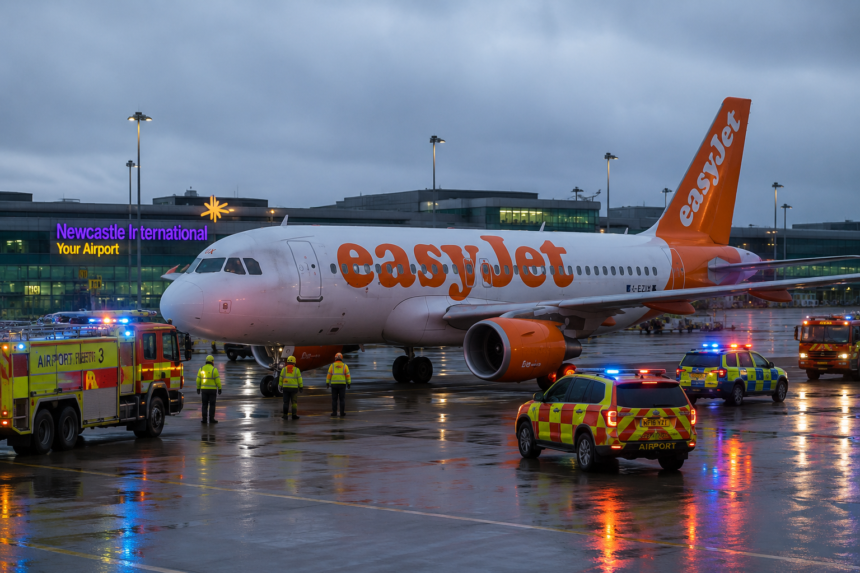
Air travel is generally one of the safest modes of transportation, but occasional in-flight emergencies remind passengers and airlines of the importance of strict safety protocols. One such incident involved EasyJet flight U2238, which was forced to make an emergency landing at Newcastle Airport after a
serious situation developed onboard. The event attracted attention across aviation news platforms due to the unexpected diversion and the operational response from the airline and air traffic control.
Overview of the Flight
EasyJet flight U2238 (also referenced as EZY238 in tracking systems) was operating a scheduled passenger service between Copenhagen and Manchester. The aircraft, an Airbus A320 family jet commonly used by EasyJet for short and medium-haul routes, had departed Copenhagen on time but later encountered an issue during its journey that required immediate attention from the flight crew.
The flight was expected to arrive in Manchester as planned, but midway through the route, the situation onboard changed, prompting the crew to divert the aircraft for safety reasons.
Reason for the Emergency Landing
According to multiple aviation reports, the emergency landing was triggered by a passenger welfare issue, commonly understood in aviation terminology as a medical emergency onboard.
In such cases, airline crews are trained to assess the severity of the situation quickly. If a passenger’s condition is considered serious and requires urgent medical attention that cannot be adequately managed in the air, the pilot may decide to divert to the nearest suitable airport.
In this incident, Newcastle Airport was identified as the safest and most practical diversion point due to its proximity and ability to handle emergency landings.
Diversion to Newcastle Airport
As the situation escalated, the captain made the decision to divert the aircraft. The plane landed safely at Newcastle Airport shortly before 11 p.m. local time.
Airport emergency services were placed on standby as a precaution, but reports confirmed that the landing itself was carried out safely without any technical issues involving the aircraft. The priority remained the passenger requiring medical assistance, who was attended to immediately upon arrival.
During the diversion, air traffic control also had to adjust nearby flight operations. Other aircraft in the area experienced minor delays as runways and airspace were temporarily managed to prioritize the emergency landing.
EasyJet’s Response
EasyJet confirmed that the diversion was caused by a medical situation onboard and emphasized that such decisions are made strictly in the interest of passenger safety.
The airline issued a statement explaining that the disruption was outside their control and classified as an “extraordinary circumstance.” This classification is standard in aviation when events such as medical emergencies, severe weather, or security issues occur.
After landing, the airline coordinated with ground teams to ensure the affected passenger received appropriate care. Once the situation was stabilized, the aircraft was prepared to continue its journey to Manchester after refueling and operational checks.
Impact on Passengers and Operations
For passengers onboard, emergency diversions can be unsettling, especially when a flight changes course unexpectedly. However, aviation safety procedures are designed to prioritize life and health above scheduling and convenience.
Passengers on flight U2238 experienced a delay in reaching their final destination, but the aircraft eventually resumed its journey after the medical situation was addressed. While inconvenient, such outcomes are considered routine in aviation when compared to the potential risks of ignoring onboard emergencies.
Additionally, the incident had a minor ripple effect on regional air traffic, briefly affecting scheduling at nearby airports due to the emergency landing priority.
Why Newcastle Airport Was Chosen
Newcastle Airport is often used as a diversion airport for flights operating between Europe and northern England or Scotland. Its selection in this case was based on several factors:
-
Proximity to the aircraft’s position at the time
-
Availability of emergency medical services
-
Suitable runway capacity for Airbus A320 operations
-
Coordination efficiency with air traffic control
These factors make it a reliable emergency landing location for flights crossing UK airspace.
Aviation Safety Perspective
From an aviation safety standpoint, the successful diversion of EasyJet flight U2238 highlights the effectiveness of modern flight operations and crew training. Pilots and cabin crew are trained extensively to handle medical emergencies, including situations where immediate decisions must be made under pressure.
Airlines also maintain constant communication with ground-based medical support teams, allowing them to evaluate passenger conditions in real time and decide whether diversion is necessary.
Conclusion
The emergency landing of EasyJet flight U2238 at Newcastle Airport serves as a reminder that passenger safety is always the highest priority in aviation. Although the situation caused disruption and delay, the swift response from the flight crew and ground emergency teams ensured that the aircraft landed safely and the affected passenger received prompt medical attention.
Such incidents, while rare, demonstrate the importance of preparedness in air travel and the ability of modern aviation systems to handle unexpected emergencies efficiently and safely.