



Introduction
Air travel is widely regarded as one of the safest forms of transportation in the world. However, when an aircraft declares an emergency, it often attracts significant public attention. One such incident involved TUI Flight BY6754, which made an emergency landing after experiencing a problem shortly after departure. While the event caused concern among passengers and aviation observers, the flight ultimately landed safely thanks to established safety procedures and the professionalism of the flight crew.
This article examines what happened during the TUI Flight BY6754 emergency landing, how the crew responded, and what the incident reveals about modern aviation safety.
Overview of TUI Flight BY6754
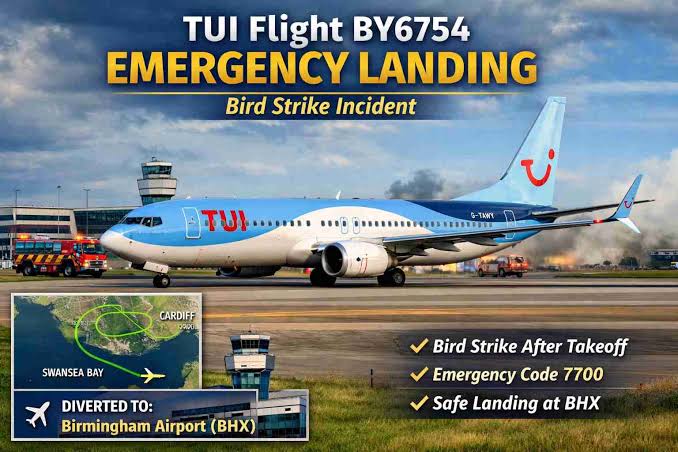
TUI Flight BY6754 was operating a scheduled service from Cardiff, Wales, to Paphos, Cyprus. Shortly after takeoff, the crew detected a technical issue that required immediate attention. Rather than continuing the journey, the pilots followed aviation safety protocols and declared an emergency.
The aircraft remained under full control throughout the event, and the crew worked closely with air traffic control to identify the safest airport for a precautionary landing. Reports indicate that the flight was diverted to Birmingham Airport, where emergency services were placed on standby as part of standard procedure.
What Triggered the Emergency?
Initial reports from passengers suggested that there may have been an engine-related problem shortly after departure. Some passengers reported unusual vibrations and a burning smell inside the aircraft cabin. These observations naturally created concern among those onboard.
Subsequent information released by the airline indicated that the aircraft had experienced a bird strike during takeoff. Bird strikes occur when birds collide with an aircraft, sometimes affecting engines or other critical systems. While many bird strikes result in little or no damage, airlines treat such incidents very seriously and often choose to divert flights as a precaution.
The crew’s decision to declare an emergency ensured that they received priority handling from air traffic control and immediate access to airport emergency services upon landing.
How the Crew Responded
One of the most important aspects of this incident was the crew’s professional response. Airline pilots undergo extensive training to manage unexpected situations, including engine issues, bird strikes, and emergency diversions.
After identifying the problem, the pilots followed established emergency checklists and communicated with air traffic controllers. The aircraft remained airborne while the crew assessed the situation and coordinated the diversion.
The flight then proceeded toward Birmingham Airport, where airport personnel prepared for the arrival of the aircraft. Emergency vehicles were positioned near the runway as a precaution, which is standard practice whenever an aircraft declares an emergency.
The aircraft landed safely without injuries to passengers or crew members.
Passenger Experience During the Incident
For passengers, emergency declarations can be stressful, especially when information is limited. Several travelers reported feeling concerned after noticing unusual sounds, vibrations, or changes in the aircraft’s behavior.
Despite these concerns, cabin crew members worked to maintain order and reassure passengers. Flight attendants are trained to assist travelers during emergencies and play a crucial role in ensuring cabin safety.
Many passengers later stated that while the experience was unsettling, they appreciated the calm and professional manner in which the situation was handled. The safe outcome reinforced confidence in airline safety procedures and crew training.
Why Emergency Landings Are Often Precautionary
The term “emergency landing” can sound alarming, but in aviation it frequently refers to a precautionary measure rather than a life-threatening event.
Airlines operate under strict safety regulations. If there is any uncertainty regarding the condition of an aircraft, pilots are encouraged to choose the safest available option. In many cases, this means diverting to a nearby airport rather than continuing the planned route.
Modern commercial aircraft are designed with multiple backup systems, and crews are trained to manage a wide range of scenarios. As a result, emergency landings often end without injuries or significant danger to those onboard.
The TUI Flight BY6754 incident is an example of how these safety systems function effectively in real-world situations.
Aviation Safety and Bird Strikes
Bird strikes are a known challenge within the aviation industry. Airports and airlines invest heavily in wildlife management programs designed to reduce the risk of collisions between birds and aircraft.
Modern jet engines are also engineered to withstand many types of bird-strike events. Even so, any potential engine impact is treated seriously and investigated thoroughly after landing.
When a bird strike is suspected, maintenance teams inspect the aircraft carefully before it returns to service. This process helps ensure continued safety for future flights.
Lessons from the Incident
The successful outcome of the TUI Flight BY6754 emergency landing highlights several important aspects of modern aviation:
- Pilot training is highly effective.
- Aircraft are designed with multiple safety systems.
- Emergency procedures are well established.
- Air traffic control provides critical support during emergencies.
- Airport emergency services are prepared for rapid response.
Together, these factors help make commercial aviation one of the safest transportation methods available.
Conclusion
The TUI Flight BY6754 emergency landing attracted attention because it involved an unexpected in-flight issue shortly after departure. However, the incident ultimately demonstrated the effectiveness of aviation safety procedures. Following reports of a bird strike and potential technical concerns, the crew diverted the aircraft and landed safely at Birmingham Airport without injuries.
While emergency landings can be unsettling for passengers, events like this show how airlines, pilots, air traffic controllers, and airport emergency teams work together to prioritize safety. The successful handling of Flight BY6754 serves as a reminder that aviation’s safety systems are designed precisely for situations like these.