



Introduction
As businesses, governments, educational institutions, and service providers demand faster and more reliable connectivity, modern networking technologies continue to evolve. One of the most important technologies supporting communication across cities is the IP Metropolitan Area Network (IP MAN).
An IP Metropolitan Area Network combines Internet Protocol (IP) networking with metropolitan-scale infrastructure to provide secure, high-speed communication between multiple locations within a city or metropolitan region. It bridges the gap between Local Area Networks (LANs) and Wide Area Networks (WANs), making it a critical component of modern digital infrastructure.
This article explains what an IP Metropolitan Area Network is, how it works, its architecture, benefits, applications, challenges, and future developments.
What Is an IP Metropolitan Area Network?
An IP Metropolitan Area Network (IP MAN) is a high-speed network that connects multiple Local Area Networks (LANs) across a city or metropolitan area using Internet Protocol (IP).
Unlike a LAN, which serves a single building or campus, an IP MAN covers a much larger geographic area. However, it is generally smaller than a Wide Area Network (WAN), which can span countries or continents.
Organizations use IP MANs to connect offices, schools, hospitals, government agencies, and data centers while maintaining fast and reliable communication.
How Does an IP MAN Work?
An IP MAN transfers data using Internet Protocol over high-speed communication infrastructure such as:
- Fiber-optic cables
- Ethernet networks
- MPLS (Multiprotocol Label Switching)
- Optical transport systems
- High-capacity routers and switches
These technologies enable data to travel efficiently between different locations while maintaining low latency and high reliability.
Architecture of an IP MAN
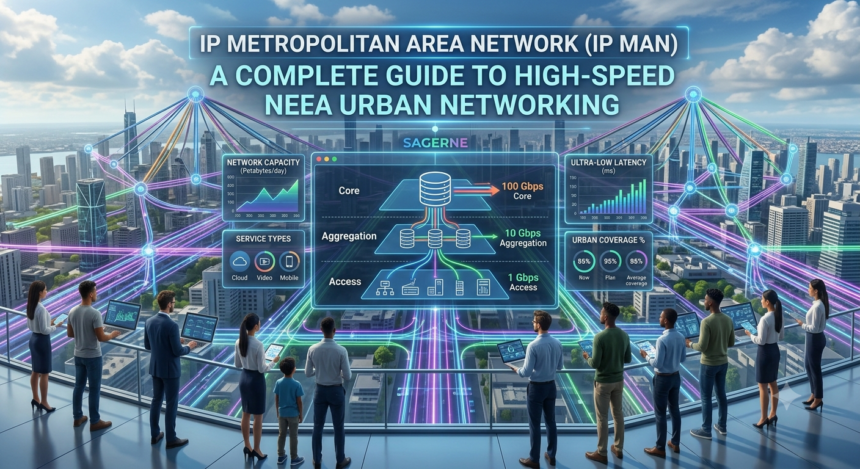
A typical IP Metropolitan Area Network consists of several key components:
Core Network
The core network carries high volumes of traffic between major network nodes using high-speed fiber connections.
Distribution Layer
This layer connects various institutions, offices, or campuses to the core network.
Access Layer
The access layer provides end users with connectivity through switches, routers, or wireless access points.
Network Management
Administrators monitor network performance, security, bandwidth usage, and fault detection using specialized management software.
Advantages of IP MAN
Organizations choose IP MANs because they provide numerous benefits.
High-Speed Connectivity
Fiber-optic infrastructure delivers fast data transfer rates suitable for modern applications.
Scalability
New locations and users can be added as organizations grow.
Cost Efficiency
Connecting multiple offices through one metropolitan network reduces communication costs.
Reliable Communication
Redundant network paths improve uptime and minimize service interruptions.
Secure Data Transmission
Encryption, firewalls, and network monitoring help protect sensitive information.
Common Applications
IP Metropolitan Area Networks support many industries.
Business Networks
Companies connect headquarters, branch offices, and data centers across a city.
Education
Universities and schools share internet access, digital learning resources, and research data.
Healthcare
Hospitals exchange medical records, imaging files, and telemedicine services securely.
Government Services
Public agencies use IP MANs to improve communication and service delivery.
Internet Service Providers
Telecommunication companies deliver broadband and enterprise connectivity using metropolitan networks.
Challenges
Although IP MANs provide many advantages, they also present challenges.
- High installation costs
- Network security risks
- Infrastructure maintenance
- Traffic congestion during peak usage
- Complex network management
Proper planning and continuous monitoring help reduce these challenges.
Security Best Practices
Organizations operating IP MANs should implement strong cybersecurity measures.
Recommended practices include:
- Firewalls
- VPN connections
- Data encryption
- Multi-factor authentication
- Intrusion detection systems
- Regular software updates
- Continuous network monitoring
These measures protect sensitive business and customer data.
The Future of IP Metropolitan Area Networks
As smart cities, cloud computing, artificial intelligence, and 5G technologies continue expanding, IP Metropolitan Area Networks will become even more important. Future developments are expected to include:
- Faster fiber-optic infrastructure
- AI-powered network management
- Software-defined networking (SDN)
- Greater automation
- Enhanced cybersecurity
- Better support for Internet of Things (IoT) devices
These innovations will improve network performance, reliability, and efficiency.
Conclusion
An IP Metropolitan Area Network (IP MAN) is a vital networking solution that connects organizations across metropolitan regions using high-speed Internet Protocol infrastructure. It offers excellent scalability, reliability, security, and performance for businesses, educational institutions, healthcare providers, government agencies, and service providers.
As cities become increasingly connected through digital technologies, IP MANs will continue playing a central role in supporting modern communication, cloud services, and smart city infrastructure. Organizations that invest in well-designed metropolitan networks are better prepared to meet the growing demands of today’s digital economy.