



Introduction
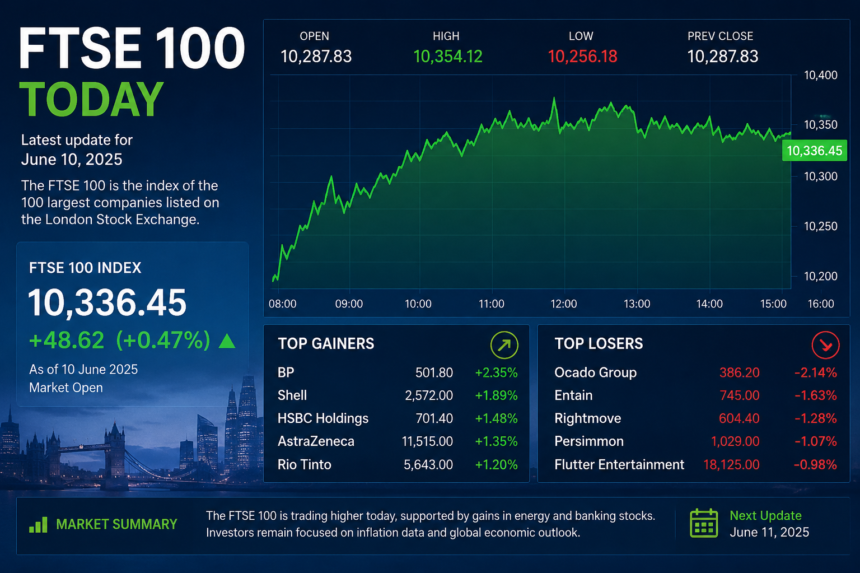
The FTSE 100 remains one of the most closely watched stock market indexes in the world. Representing the 100 largest companies listed on the London Stock Exchange, the index serves as a key indicator of the health of the UK economy and investor confidence. Today, the FTSE 100 continues to attract attention from traders, investors, and financial analysts who monitor its movements for signs of broader market trends.
Recent trading sessions have shown mixed performance as investors react to economic data, geopolitical developments, and corporate earnings reports. While some sectors have posted gains, others have faced pressure due to uncertainty in global markets. As a result, the FTSE 100 has experienced moderate fluctuations while remaining near historically strong levels.
What Is the FTSE 100?
The FTSE 100, often referred to as the “Footsie,” is a stock market index comprising the 100 largest publicly traded companies on the London Stock Exchange based on market capitalization. It includes businesses from a variety of industries, including banking, energy, mining, healthcare, consumer goods, and telecommunications.
Because many FTSE 100 companies generate significant revenue outside the United Kingdom, the index is often influenced by global economic conditions as much as domestic events.
FTSE 100 Performance Today
Today’s market environment reflects ongoing investor caution. Recent sessions have seen the index move within a relatively narrow range as traders assess economic indicators and international developments. The FTSE 100 recently traded around the 10,300–10,400 level, demonstrating resilience despite market uncertainties.
Market participants are particularly focused on inflation expectations, interest rate policies, and geopolitical tensions. These factors continue to shape investor sentiment and influence buying and selling activity across major sectors.
Although short-term volatility remains present, the FTSE 100 has maintained a generally strong position compared with many historical periods.
Key Sectors Driving the Market
Energy Companies
Energy stocks continue to play a major role in the performance of the FTSE 100. Rising oil prices and concerns about global energy supplies have supported major oil and gas companies. Investors often view energy firms as defensive holdings during periods of uncertainty.
Banking Sector
Banks remain another important component of the index. Interest rate expectations significantly affect bank profitability. Higher rates can improve lending margins, although economic slowdowns may reduce borrowing activity.
Mining Stocks
Mining companies have shown varying performance depending on commodity prices and global demand. Developments in emerging markets and industrial production trends often influence this sector.
Consumer and Retail Stocks
Consumer-focused businesses are closely linked to household spending. Inflation, wage growth, and consumer confidence can all impact retail performance within the index.
Factors Influencing the FTSE 100 Today
Global Geopolitical Events
International tensions remain a major market driver. Investors are monitoring developments in the Middle East and other regions that could affect energy prices, trade flows, and global economic stability. Recent market movements have reflected concerns about geopolitical risks and their potential economic consequences.
Inflation and Interest Rates
Inflation continues to influence investment decisions worldwide. Any signs that inflation is easing can boost market confidence because it may reduce pressure on central banks to maintain higher interest rates.
Recent economic data has suggested that inflationary pressures may be moderating, providing some support for equity markets.
Corporate Earnings
Company earnings reports remain a critical factor for stock performance. Strong financial results often support share prices, while disappointing results can trigger declines. Investors closely analyze revenue growth, profit margins, and future guidance when evaluating FTSE 100 companies.
Changes Within the FTSE 100
The composition of the FTSE 100 is reviewed regularly to ensure it accurately reflects the largest companies in the UK market. Recent index reviews have led to several additions and removals as company valuations change over time.
During the latest review, Aberdeen Group, Computacenter, and Investec were selected to join the FTSE 100, while Berkeley Group Holdings, Mondi, and Rightmove moved out of the index. These adjustments help maintain the relevance and accuracy of the benchmark.
Investor Sentiment
Investor sentiment today remains cautiously optimistic. While concerns about global economic growth persist, many market participants believe that strong corporate fundamentals and resilient business performance can continue to support the index.
The FTSE 100 also benefits from its exposure to multinational companies that generate revenue across numerous international markets. This diversification often helps reduce the impact of domestic economic challenges.
Long-term investors continue to view the FTSE 100 as an important component of diversified investment portfolios due to its broad sector representation and established companies.
Outlook for the Coming Weeks
Looking ahead, market direction will likely depend on upcoming economic data, central bank decisions, and geopolitical developments. Investors will watch inflation reports, employment figures, and corporate earnings announcements for clues about future market trends.
If inflation continues to ease and economic conditions remain stable, the FTSE 100 could find additional support. However, unexpected global events or weaker-than-expected economic performance could increase volatility.
Conclusion
The FTSE 100 today reflects a market balancing optimism with caution. Supported by major energy, banking, and multinational companies, the index remains one of the world’s most important stock market benchmarks. While short-term fluctuations are expected, investors continue to monitor economic indicators, corporate earnings, and global developments for guidance on future performance.
As financial markets evolve, the FTSE 100 will remain a crucial measure of investor confidence and economic activity, making it an essential index for anyone interested in global investing and market trends.