

Introduction
Launching a startup is an exciting journey, but one of the first and most important decisions founders face is how to finance their business. Should you bootstrap the company using personal resources and revenue, or should you raise external funding from angel investors or venture capital firms?
There is no universal answer. Both strategies have helped build successful companies, and the right choice depends on your business model, market opportunity, growth goals, and financial situation. Understanding the strengths and challenges of each approach can help founders make informed decisions.
This article explores bootstrapping and fundraising, compares their advantages and disadvantages, and provides guidance on choosing the best strategy for your startup.
What Is Bootstrapping?
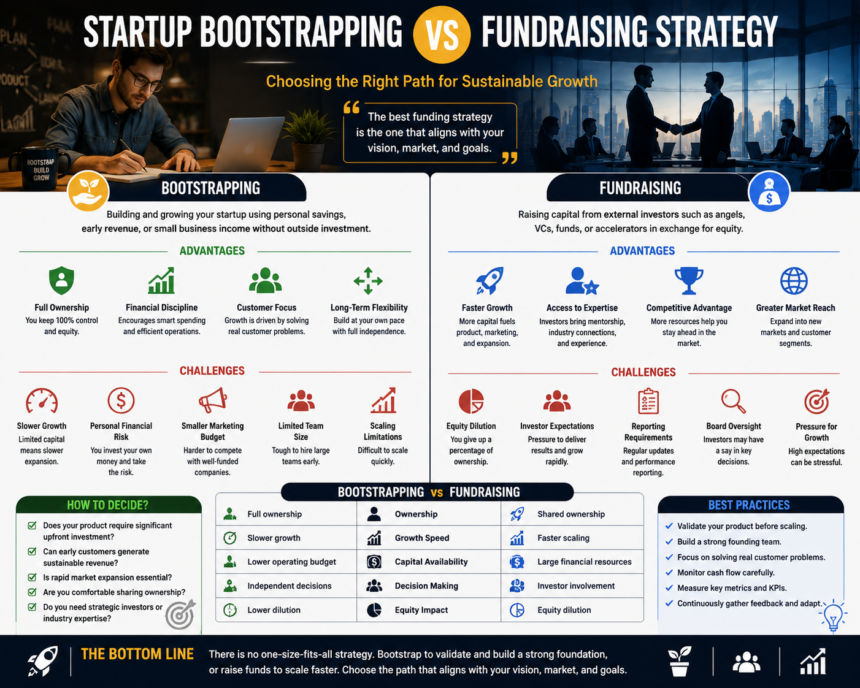
Bootstrapping is the process of building and growing a startup using personal savings, early customer revenue, or small business income instead of outside investment.
Bootstrapped founders maintain full ownership of their company and make decisions independently without pressure from external investors.
Many successful businesses began by bootstrapping until they achieved stable revenue and sustainable growth.
Advantages of Bootstrapping
Full Ownership
Founders retain complete control over company decisions and equity.
Financial Discipline
Limited resources encourage careful spending and efficient operations.
Customer Focus
Growth depends on solving real customer problems rather than meeting investor expectations.
Long-Term Flexibility
Without investor pressure, founders can build at their own pace and adjust strategies when needed.
Challenges of Bootstrapping
Bootstrapping also has limitations.
- Slower growth due to limited capital.
- Personal financial risk.
- Smaller marketing budgets.
- Difficulty hiring large teams early.
- Limited ability to scale quickly.
Despite these challenges, many founders prefer maintaining independence.
What Is Fundraising?
Fundraising involves securing capital from external investors such as:
- Angel investors
- Venture capital firms
- Seed funds
- Startup accelerators
- Crowdfunding platforms
In exchange for funding, investors usually receive equity or another financial interest in the company.
Advantages of Fundraising
Faster Growth
Additional capital allows startups to hire employees, develop products, and expand rapidly.
Access to Expertise
Experienced investors often provide mentorship, business advice, and industry connections.
Competitive Advantage
Well-funded startups can invest more in product development, marketing, and customer acquisition.
Greater Market Reach
Funding enables expansion into new regions and customer segments.
Challenges of Fundraising
External investment also introduces new responsibilities.
- Equity dilution.
- Investor expectations.
- Board oversight.
- Regular reporting requirements.
- Pressure for rapid growth.
Founders must balance growth with maintaining their long-term vision.
Bootstrapping vs. Fundraising
| Bootstrapping | Fundraising |
|---|---|
| Full ownership | Shared ownership |
| Slower growth | Faster scaling |
| Lower operating budget | Larger financial resources |
| Independent decisions | Investor involvement |
| Lower dilution | Equity dilution |
Neither option is universally better. Success depends on the startup’s goals and market conditions.
How to Decide
Consider these questions before choosing a funding strategy:
- Does your product require significant upfront investment?
- Can early customers generate sustainable revenue?
- Is rapid market expansion essential?
- Are you comfortable sharing ownership?
- Do you need strategic investors or industry expertise?
Your answers will help determine the most suitable path.
Hybrid Approach
Many startups combine both strategies.
A founder may bootstrap the business until reaching product-market fit and generating initial revenue. Once the business demonstrates traction, raising external funding becomes easier and often results in better valuation terms.
This hybrid model reduces risk while preserving more founder ownership.
Best Practices for Founders
Regardless of your funding approach:
- Validate your product before scaling.
- Build a strong founding team.
- Focus on solving real customer problems.
- Monitor cash flow carefully.
- Measure key performance indicators (KPIs).
- Continuously gather customer feedback.
- Adapt based on market demand.
Strong execution is often more important than the funding method itself.
Conclusion
Choosing between bootstrapping and fundraising is one of the most important strategic decisions for any startup. Bootstrapping offers independence, financial discipline, and full ownership, while fundraising provides the capital and resources needed for rapid growth.
Many successful companies have followed both paths, proving that there is no single formula for success. By understanding your market, validating your product, and aligning your financing strategy with your long-term vision, you can build a stronger and more sustainable startup capable of thriving in an increasingly competitive business landscape.