



Introduction
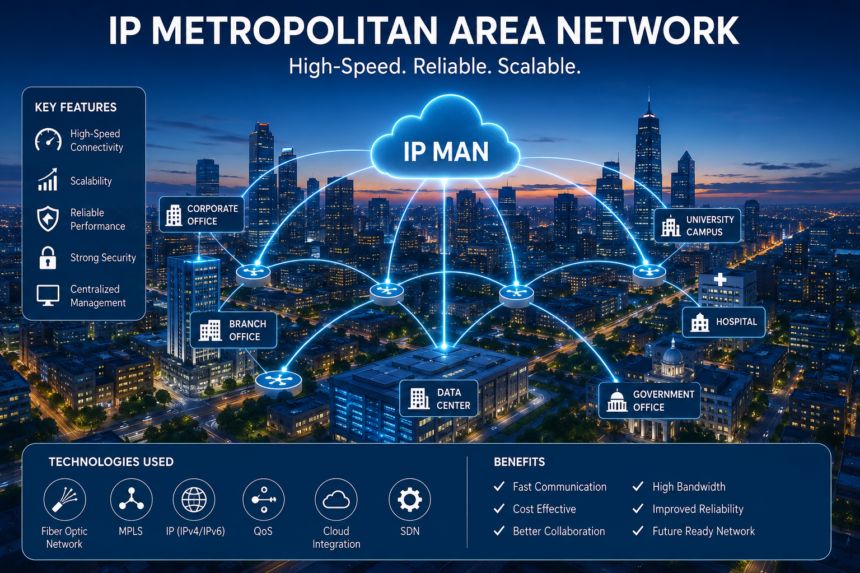
An IP Metropolitan Area Network (IP MAN) is a high-speed communication network designed to connect multiple locations within a city or metropolitan region using Internet Protocol (IP). It serves as a bridge between Local Area Networks (LANs) and Wide Area Networks (WANs), providing organizations, government agencies, educational institutions, healthcare providers, and Internet Service Providers (ISPs) with reliable and efficient connectivity across urban areas.
As cities continue to embrace digital transformation, IP Metropolitan Area Networks have become an essential part of modern communication infrastructure. They support everything from cloud computing and smart city applications to video conferencing, online education, and secure data sharing. Their ability to deliver fast, scalable, and cost-effective networking solutions makes them a preferred choice for organizations operating across multiple sites within the same metropolitan region.
What Is an IP Metropolitan Area Network?
An IP Metropolitan Area Network is a network that uses Internet Protocol to connect geographically separated buildings or offices within a city. Unlike a LAN, which is limited to a single building or campus, an IP MAN spans a much larger area while maintaining high-speed data communication.
These networks commonly rely on fiber-optic cables, Ethernet technologies, and high-capacity routers and switches to provide seamless connectivity. Depending on the organization’s requirements, the network may be privately owned or leased from a telecommunications provider.
How an IP MAN Works
An IP Metropolitan Area Network connects multiple local networks through a central backbone. Data travels in the form of IP packets between connected locations using advanced routing technologies.
The network typically consists of:
- High-speed fiber-optic backbone
- Core routers and switches
- Distribution switches
- Customer access devices
- Security systems such as firewalls
- Network monitoring and management tools
When users send information, the data is routed efficiently through the network to reach its destination with minimal delay. Modern IP MANs are designed to support voice, video, and data traffic simultaneously while maintaining excellent performance.
Key Features of IP Metropolitan Area Networks
High-Speed Connectivity
Most IP MANs support Gigabit and even multi-Gigabit transmission speeds. This enables organizations to transfer large files, run cloud applications, and conduct high-definition video meetings without interruptions.
Scalability
Businesses can easily add new offices, campuses, or departments without redesigning the entire network infrastructure. This flexibility supports future growth.
Reliable Performance
Many IP MAN deployments include redundant network paths and backup equipment. If one connection fails, traffic can automatically switch to another route, minimizing downtime.
Centralized Network Management
Administrators can monitor, configure, and troubleshoot all connected locations from a central management platform, reducing operational complexity.
Strong Security
Security features such as Virtual Private Networks (VPNs), encryption, firewalls, intrusion detection systems, and access control help protect sensitive business information from cyber threats.
Advantages of IP Metropolitan Area Networks
Organizations choose IP MANs for several reasons:
- Fast communication between multiple offices
- Lower operational costs compared to maintaining separate networks
- Improved collaboration among employees
- Support for cloud services and virtualization
- High bandwidth for data-intensive applications
- Simplified network administration
- Better disaster recovery capabilities
- Increased reliability and availability
These advantages make IP MANs suitable for organizations that require dependable connectivity across urban locations.
Common Applications
Business Organizations
Companies with multiple branch offices use IP MANs to connect employees, share files, access centralized databases, and operate enterprise software efficiently.
Educational Institutions
Universities and colleges often connect multiple campuses through an IP MAN, allowing students and faculty to access shared learning platforms, research databases, and administrative systems.
Healthcare Services
Hospitals and clinics use metropolitan networks to exchange patient records securely, conduct telemedicine consultations, and support medical imaging applications that require high bandwidth.
Government Agencies
Municipal governments rely on IP MANs to connect offices, surveillance systems, emergency services, and smart city infrastructure.
Internet Service Providers
ISPs deploy metropolitan networks to distribute internet services efficiently across neighborhoods and business districts.
Technologies Used in IP MAN
Several technologies contribute to the performance of an IP Metropolitan Area Network:
- Fiber-optic communication
- Ethernet over fiber
- MPLS (Multiprotocol Label Switching)
- IPv4 and IPv6 protocols
- Quality of Service (QoS)
- Software-Defined Networking (SDN)
- Network virtualization
- Cloud integration technologies
These technologies improve network speed, flexibility, and overall efficiency.
Challenges
Despite their advantages, IP Metropolitan Area Networks also face certain challenges.
High Initial Investment
Deploying fiber infrastructure and networking equipment can require significant upfront costs.
Network Security
As networks become more interconnected, protecting sensitive information from cyberattacks becomes increasingly important.
Maintenance
Regular monitoring, hardware upgrades, and software updates are necessary to maintain optimal performance.
Bandwidth Management
Organizations must carefully manage network traffic to prevent congestion during peak usage periods.
Future of IP Metropolitan Area Networks
The future of IP Metropolitan Area Networks is closely linked with emerging technologies. The expansion of 5G, artificial intelligence, edge computing, Internet of Things (IoT), and smart city initiatives will increase the demand for faster and more intelligent metropolitan networking solutions.
Future IP MANs will feature greater automation, predictive maintenance powered by AI, enhanced cybersecurity, and even higher bandwidth capacities. Software-defined networking and cloud-native architectures will further improve flexibility and operational efficiency.
As digital services continue to grow, metropolitan networks will play an even more critical role in supporting businesses, public services, and connected communities.
Conclusion
An IP Metropolitan Area Network is a vital communication infrastructure that enables high-speed connectivity across cities and metropolitan regions. By combining reliability, scalability, security, and efficient network management, IP MANs provide organizations with the foundation needed for modern digital operations.
Whether supporting businesses, educational institutions, healthcare organizations, government agencies, or internet service providers, IP Metropolitan Area Networks continue to drive innovation and improve communication. As technology evolves, these networks will remain an essential component of smart, connected cities and the digital economy.