


Introduction
Geometry is one of the oldest and most important branches of mathematics. It helps us understand shapes, sizes, angles, distances, and the properties of space around us. From the design of buildings and bridges to computer graphics and engineering, geometry plays a major role in many aspects of everyday life. With the advancement of educational technology, learning geometry has become easier and more interactive than ever before. Geometry Learn V3 represents a modern approach to mastering geometric concepts through digital learning tools and structured educational methods.
What Is Geometry?
Geometry is the study of shapes, lines, angles, surfaces, and solids. It focuses on understanding the relationships between different mathematical objects. Students typically begin learning geometry with basic concepts such as points, lines, and angles before moving on to more advanced topics like polygons, circles, coordinate geometry, and three-dimensional figures.
Geometry helps develop logical thinking and problem-solving skills. It encourages students to visualize objects and understand how different elements connect within a mathematical framework.
The Purpose of Geometry Learn V3
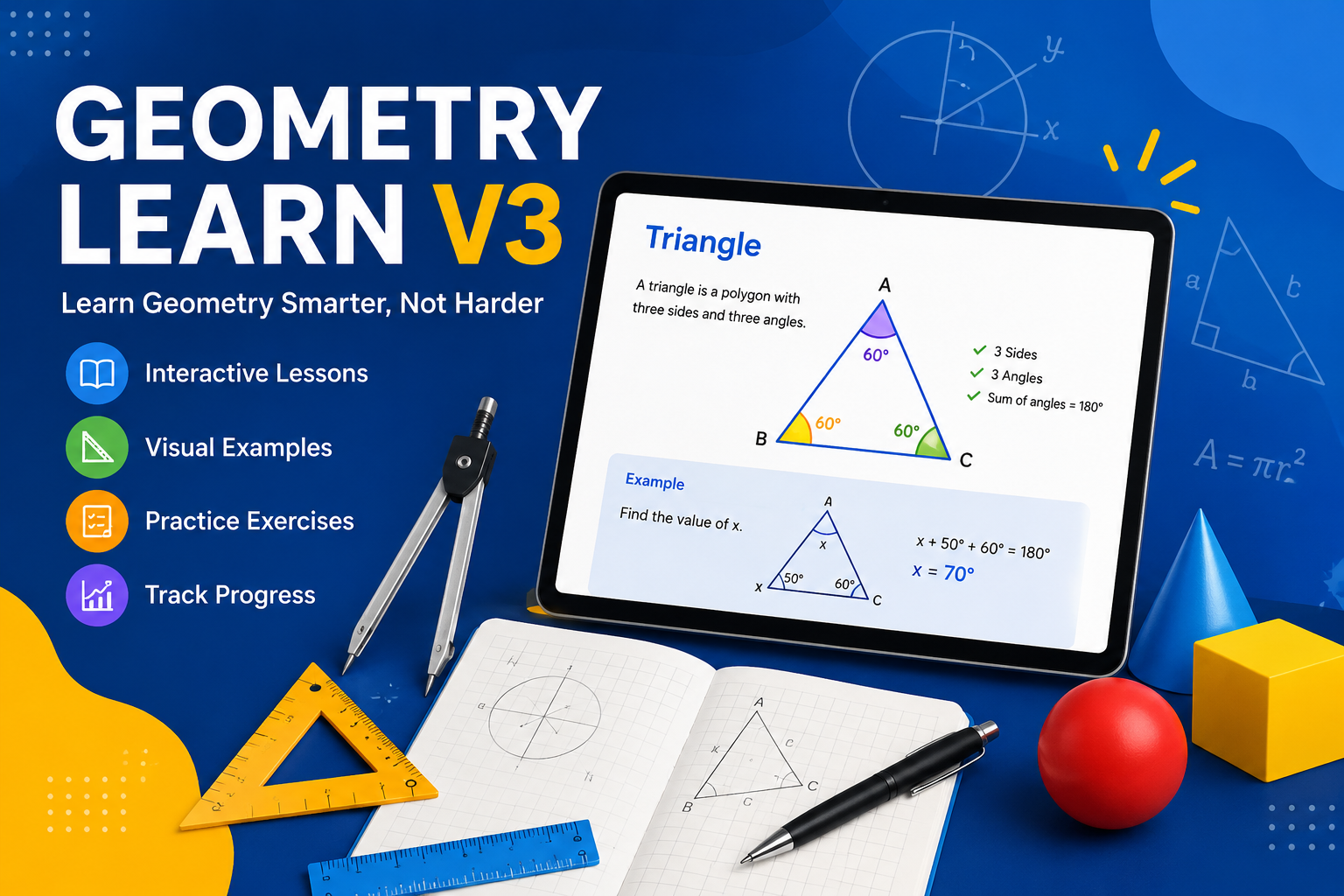
Geometry Learn V3 is designed to make geometry education more accessible and engaging. Traditional geometry lessons often rely heavily on textbooks and static diagrams. While these methods are effective, modern learners benefit from interactive content that allows them to explore concepts visually and practically.
The primary goal of Geometry Learn V3 is to simplify complex geometric ideas while helping learners build confidence in their mathematical abilities. Through structured lessons, visual demonstrations, and practice exercises, users can improve their understanding of geometry step by step.
Key Topics Covered
A comprehensive geometry learning platform typically includes several important topics. Geometry Learn V3 focuses on the following areas:
Points, Lines, and Planes
These are the fundamental building blocks of geometry. Students learn how points represent locations, lines extend infinitely in both directions, and planes form flat surfaces.
Angles
Understanding angles is essential for solving many geometric problems. Learners explore acute, obtuse, right, straight, and reflex angles while practicing angle measurements and relationships.
Triangles
Triangles are among the most studied shapes in geometry. Geometry Learn V3 introduces different types of triangles, including equilateral, isosceles, and scalene triangles. Students also learn about triangle properties, congruence, and similarity.
Polygons
Polygons are closed shapes with multiple sides. Learners study quadrilaterals, pentagons, hexagons, and other polygon types while understanding their characteristics and formulas.
Circles
Circle geometry includes concepts such as radius, diameter, circumference, chords, arcs, and sectors. These concepts form an important foundation for advanced mathematical studies.
Coordinate Geometry
Coordinate geometry combines algebra and geometry by using graphs and coordinates. Students learn how to plot points, calculate distances, and analyze geometric figures on a coordinate plane.
Three-Dimensional Shapes
Geometry Learn V3 also introduces solid figures such as cubes, spheres, cylinders, cones, and pyramids. Learners explore volume, surface area, and spatial relationships.
Benefits of Using Geometry Learn V3
Modern geometry learning systems provide several advantages compared to traditional learning methods.
Interactive Learning
Visual representations help students understand abstract concepts more effectively. Interactive diagrams allow learners to manipulate shapes and observe how geometric properties change.
Self-Paced Education
Every student learns at a different speed. Geometry Learn V3 enables users to progress through lessons according to their own learning pace, reducing pressure and improving comprehension.
Immediate Feedback
Practice exercises often provide instant feedback, helping students identify mistakes and correct them quickly. This approach supports continuous improvement.
Enhanced Visualization Skills
Geometry requires strong visualization abilities. Interactive tools strengthen spatial reasoning by allowing students to view shapes from different perspectives.
Improved Problem-Solving
Regular practice with geometric challenges helps learners develop analytical thinking skills that are valuable in mathematics and many professional fields.
Real-World Applications of Geometry
One of the most exciting aspects of geometry is its practical usefulness. Geometry is applied in numerous industries and professions.
Architecture
Architects use geometric principles to design buildings, homes, and public structures. Accurate measurements and spatial planning are essential for successful construction projects.
Engineering
Engineers rely on geometry when designing machines, roads, bridges, and mechanical systems. Precision is critical in engineering work.
Computer Graphics
Modern video games, animations, and digital designs use geometric calculations to create realistic visual environments and effects.
Navigation
Maps, GPS systems, and geographic information technologies use geometry to calculate distances and determine locations.
Art and Design
Artists and designers frequently use geometric patterns, symmetry, and proportions to create visually appealing works.
Tips for Learning Geometry Successfully
Students can improve their geometry skills by following a few effective strategies:
- Practice regularly with different types of problems.
- Draw diagrams whenever possible to visualize concepts.
- Memorize important formulas and understand their applications.
- Use interactive tools to explore geometric relationships.
- Review mistakes carefully and learn from them.
- Connect geometric concepts to real-world examples.
Consistent practice and curiosity are key factors in mastering geometry.
The Future of Geometry Education
Educational technology continues to transform the way students learn mathematics. Platforms like Geometry Learn V3 demonstrate how digital tools can make complex subjects more engaging and understandable. Features such as interactive simulations, visual demonstrations, and personalized learning paths are helping students achieve better outcomes.
As technology evolves, geometry education is expected to become even more immersive, incorporating advanced visualization techniques and intelligent learning systems that adapt to individual needs.
Conclusion
Geometry Learn V3 represents a modern and effective approach to studying geometry. By combining traditional mathematical principles with interactive educational technology, it helps learners develop a deeper understanding of shapes, measurements, and spatial relationships. Whether a student is preparing for exams, strengthening mathematical skills, or exploring geometry out of personal interest, Geometry Learn V3 offers valuable tools and resources for success. Through consistent practice and engagement, learners can build confidence and unlock the many practical applications of geometry in the real world.