



Introduction
As digital communication continues to evolve, organizations require fast, secure, and reliable networks to connect multiple locations. Businesses, universities, hospitals, government agencies, and internet service providers all depend on networking technologies that deliver high performance over large geographic areas. One of the most effective solutions for connecting multiple locations within a city is the IP Metropolitan Area Network (IP MAN).
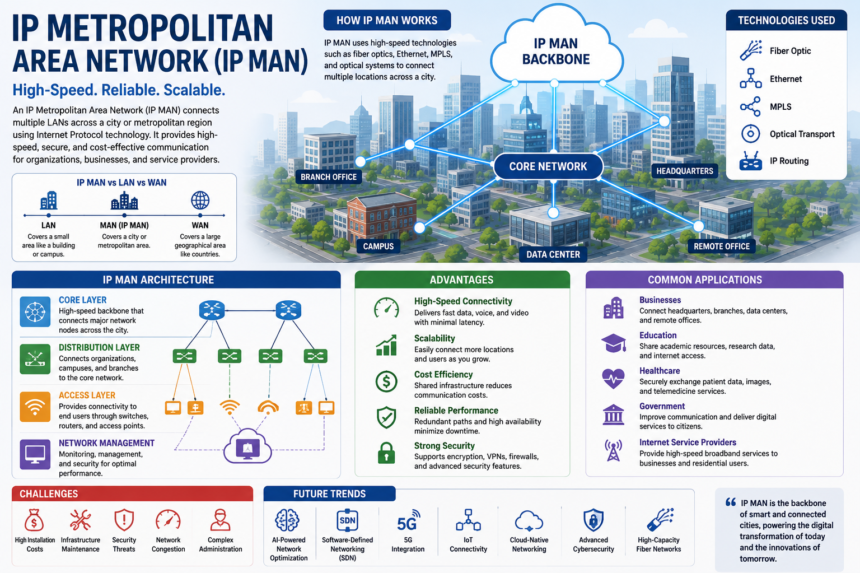
An IP Metropolitan Area Network combines Internet Protocol (IP) technology with metropolitan-scale infrastructure, creating a network that connects several Local Area Networks (LANs) across a city or metropolitan region. It fills the gap between small local networks and large wide-area networks, providing an ideal balance of speed, scalability, and reliability.
This guide explains how IP MANs work, their architecture, benefits, applications, challenges, and future developments.
What Is an IP Metropolitan Area Network?
An IP Metropolitan Area Network (IP MAN) is a high-speed communication network that uses Internet Protocol to connect multiple LANs within a metropolitan area.
Unlike a Local Area Network (LAN), which covers a single building or campus, an IP MAN spans an entire city or urban region. It is typically smaller than a Wide Area Network (WAN), which connects locations across countries or continents.
Organizations rely on IP MANs to share data, voice, video, cloud services, and internet connectivity efficiently.
How Does an IP MAN Work?
An IP MAN transmits data using high-speed networking technologies such as:
- Fiber-optic infrastructure
- Ethernet networks
- MPLS (Multiprotocol Label Switching)
- Optical transport systems
- Enterprise routers and switches
These technologies enable secure and efficient communication between multiple offices, campuses, or facilities.
Architecture of an IP MAN
A typical IP Metropolitan Area Network consists of several important components.
Core Network
The core network forms the backbone of the system, carrying large amounts of traffic between major network nodes at very high speeds.
Distribution Layer
This layer connects organizations, campuses, and branch offices to the core infrastructure.
Access Layer
The access layer provides connectivity to end users through switches, routers, and wireless access points.
Network Management
Administrators use monitoring tools to supervise bandwidth usage, performance, security, and network availability.
Advantages of IP MAN
High-Speed Connectivity
Fiber-optic technology enables extremely fast data transmission with minimal latency.
Scalability
Organizations can easily connect additional buildings or users as they expand.
Cost Efficiency
Sharing one metropolitan network often reduces communication costs compared to maintaining separate connections.
Reliable Performance
Redundant infrastructure minimizes downtime and improves network availability.
Strong Security
Modern IP MANs support encrypted communication, firewalls, VPNs, and advanced security monitoring.
Common Applications
IP Metropolitan Area Networks support many industries and organizations.
Businesses
Companies connect headquarters, branch offices, warehouses, and data centers throughout a city.
Educational Institutions
Universities and schools share learning resources, research data, and internet access.
Healthcare
Hospitals exchange medical records, diagnostic images, and telemedicine services securely.
Government Agencies
Public organizations use metropolitan networks to improve communication and digital service delivery.
Internet Service Providers
Telecommunication companies use metropolitan infrastructure to deliver broadband services to businesses and residential customers.
Challenges
Although IP MANs provide many benefits, organizations must also address several challenges.
- High installation costs
- Infrastructure maintenance
- Cybersecurity risks
- Network congestion
- Complex administration
Proper planning and ongoing maintenance help reduce these issues.
Security Best Practices
Because metropolitan networks carry sensitive information, strong cybersecurity is essential.
Recommended security measures include:
- Firewalls
- VPN connectivity
- End-to-end encryption
- Multi-factor authentication
- Intrusion detection systems
- Regular software updates
- Continuous network monitoring
These protections help maintain confidentiality, integrity, and availability.
Future Trends
The future of IP Metropolitan Area Networks is closely connected with technological innovation.
Emerging trends include:
- Artificial intelligence for network optimization
- Software-Defined Networking (SDN)
- 5G integration
- Internet of Things (IoT) connectivity
- Cloud-native networking
- Automated cybersecurity monitoring
- Higher-capacity fiber infrastructure
These technologies will make metropolitan networks faster, smarter, and more efficient.
Conclusion
An IP Metropolitan Area Network (IP MAN) is an essential networking solution that enables high-speed communication across metropolitan regions. It provides businesses, educational institutions, healthcare providers, governments, and internet service providers with secure, scalable, and reliable connectivity.
As cities become increasingly connected through smart technologies, cloud computing, and digital transformation, IP MANs will continue to play a crucial role in supporting communication, collaboration, and innovation. Organizations that invest in modern metropolitan networking infrastructure are better positioned to meet the growing demands of today’s digital world.