


Introduction
The Washington Commanders vs Chargers match player stats reveal an exciting contest filled with standout individual performances, strategic adjustments, and game-changing plays. Every NFL matchup offers valuable insights beyond the final score, and this game was no exception. From quarterback efficiency to defensive pressure, the statistics tell the story of how momentum shifted throughout the contest.
Whether you’re a dedicated NFL fan or simply interested in analyzing football performance, understanding player statistics helps explain why certain teams succeed and where improvements are needed.
Game Overview
The matchup between the Washington Commanders and the Los Angeles Chargers featured explosive offense, disciplined defense, and several momentum-changing moments. Washington eventually secured a convincing 27-10 victory after overcoming an early deficit. The Commanders relied on an effective rushing attack and a balanced passing game, while their defense consistently pressured the Chargers’ offense.
Washington Commanders Offensive Player Stats
Quarterback Performance
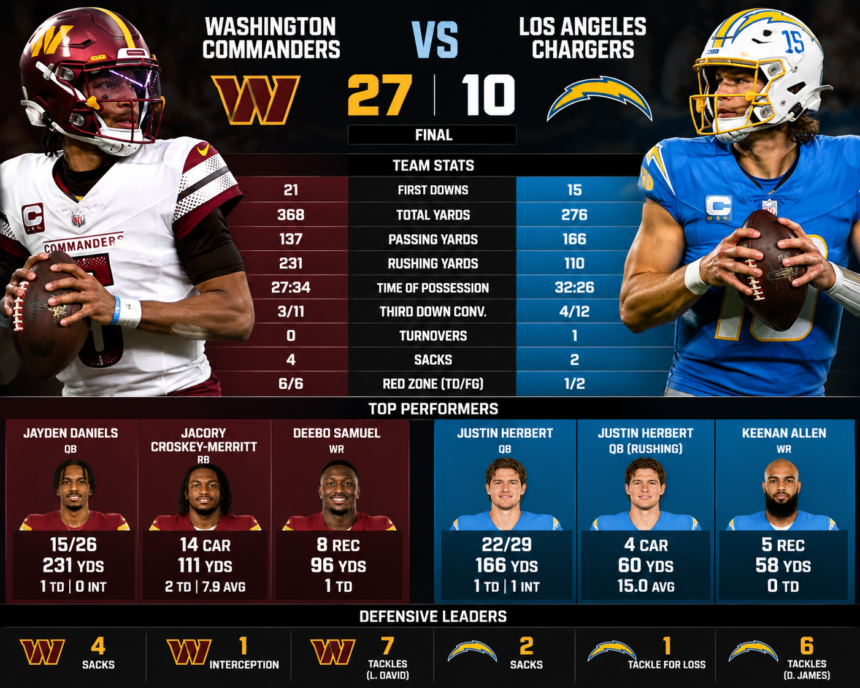
Quarterback Jayden Daniels delivered another composed performance. He completed 15 of 26 passes for 231 yards, threw one touchdown, and avoided interceptions. His ability to extend plays and make accurate throws under pressure helped Washington control the game after halftime.
Running Game
The biggest offensive star for Washington was Jacory Croskey-Merritt.
His impressive numbers included:
- 14 rushing attempts
- 111 rushing yards
- 2 rushing touchdowns
- 7.9 yards per carry
His explosive runs consistently moved the chains and allowed Washington to dominate time of possession.
Receiving Leaders
Deebo Samuel was Daniels’ favorite target throughout the game.
His performance included:
- 8 receptions
- 96 receiving yards
- 1 touchdown
Samuel repeatedly created separation and made several important catches during key drives.
Los Angeles Chargers Offensive Player Stats
Justin Herbert’s Passing Numbers
Justin Herbert started the game well but struggled once Washington’s defense adjusted.
His final statistics were:
- 22 completions on 29 attempts
- 166 passing yards
- 1 touchdown
- 1 interception
Although Herbert completed a high percentage of his passes, the Commanders prevented explosive plays and forced shorter completions.
Chargers Rushing Attack
The Chargers failed to establish a consistent running game. Surprisingly, Justin Herbert finished as one of the team’s leading rushers with:
- 4 carries
- 60 rushing yards
Much of that production came on scrambling plays rather than designed runs.
Receiving Performance
Keenan Allen led the Chargers’ receiving corps with:
- 5 receptions
- 58 receiving yards
Despite several solid catches, Washington’s secondary prevented him from making game-changing plays.
Defensive Standouts
Washington’s defense played a major role in securing the victory.
Key defensive achievements included:
- Multiple quarterback pressures
- Four sacks
- One interception
- Strong red-zone defense
Consistent pressure disrupted Herbert’s rhythm and prevented the Chargers from sustaining drives after the first quarter.
The Chargers’ defense performed well early but gradually wore down as Washington’s running game gained momentum.
Team Statistical Comparison
A comparison of the overall performances shows why Washington controlled the game.
Washington Commanders
- Balanced passing attack
- 111 rushing yards from Croskey-Merritt
- Zero interceptions thrown
- Strong defensive pressure
- Efficient red-zone scoring
Los Angeles Chargers
- Accurate short passing
- Limited rushing production
- One costly interception
- Difficulty protecting the quarterback
- Offensive slowdown after the first quarter
Key Turning Points
Several moments changed the course of the game.
Commanders’ Running Game
Washington established physical dominance with an effective rushing attack that kept the Chargers’ defense on the field.
Defensive Pressure
The Commanders’ pass rush consistently forced Herbert into uncomfortable situations, leading to stalled drives.
Efficient Passing
Jayden Daniels avoided mistakes while converting important third downs through accurate passing.
Second-Half Adjustments
Washington completely controlled the second half, scoring consistently while preventing Los Angeles from adding points after the opening quarter.
Individual Player Highlights
Best Offensive Player
Jacory Croskey-Merritt
His two rushing touchdowns and over 100 rushing yards made him one of the biggest reasons for Washington’s victory.
Best Quarterback
Jayden Daniels
Daniels demonstrated maturity by protecting the football while delivering efficient passing production.
Best Receiver
Deebo Samuel
His ability to create separation and score in the fourth quarter helped seal the victory.
Defensive MVP
Washington’s defensive front deserves significant credit for generating four sacks and forcing constant pressure on Justin Herbert.
What These Player Stats Tell Us
The numbers highlight several important conclusions:
- Washington succeeded through offensive balance rather than relying on one player.
- The rushing attack opened passing opportunities.
- Daniels protected the football, increasing offensive efficiency.
- The Chargers struggled once their running game disappeared.
- Defensive pressure remains one of Washington’s biggest strengths.
Statistics often reveal trends that aren’t immediately obvious while watching the game, and this matchup clearly showed the importance of complementary football.
Final Thoughts
The Washington Commanders vs Chargers match player stats demonstrate how balanced offense and disciplined defense can overcome an early deficit. Washington excelled in nearly every important statistical category, including rushing efficiency, quarterback protection, turnovers, and defensive pressure.
Outstanding performances from Jayden Daniels, Jacory Croskey-Merritt, and Deebo Samuel powered the offense, while the Commanders’ defense consistently disrupted Justin Herbert and limited the Chargers’ scoring opportunities. For football fans and analysts alike, this game serves as an excellent example of how team execution and individual performances combine to produce a convincing NFL victory.