



Introduction
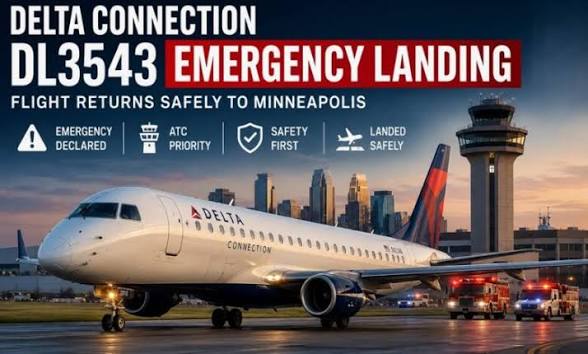
Air travel is widely regarded as one of the safest forms of transportation in the world. However, whenever a flight declares an emergency and returns to the airport, it naturally attracts public attention. That was the case with Delta Connection Flight DL3543, which made a precautionary emergency landing shortly after departure in 2025.
Although headlines describing an “emergency landing” may sound alarming, the incident actually demonstrated how modern aviation safety systems work exactly as intended. The aircraft landed safely, no injuries were reported, and passengers were able to disembark normally.
Overview of Delta Connection DL3543
Delta Connection Flight DL3543 was operated by Endeavor Air, a regional airline that flies under the Delta Connection brand. The flight departed from Minneapolis–Saint Paul International Airport (MSP) and was scheduled to travel to Chicago Midway International Airport (MDW).
Shortly after takeoff, the flight crew received an indication related to the aircraft’s pressurization system. Following established safety procedures, the pilots declared an emergency and decided to return to Minneapolis rather than continue the flight.
What Triggered the Emergency?
According to reports discussing the incident, the crew noticed a pressurization-related indication during the climb phase of the flight. Cabin pressurization is a critical system that allows aircraft to maintain a comfortable and safe environment for passengers while flying at high altitudes.
Importantly, a pressurization alert does not necessarily mean that the aircraft has suffered a major failure. Sometimes warnings can be triggered by sensors, valves, or other system irregularities that require inspection. Aviation procedures require crews to treat such alerts seriously and take immediate action if necessary.
The Crew’s Response
One of the most important aspects of the DL3543 incident was the professionalism of the flight crew.
After receiving the warning indication, the pilots:
- Contacted Air Traffic Control (ATC)
- Declared an emergency
- Requested priority handling
- Initiated a controlled return to the departure airport
- Followed all established safety procedures
These actions were not signs of panic. Instead, they reflected standard aviation practices designed to minimize risk and maximize passenger safety.
Safe Return to Minneapolis
Following the emergency declaration, the aircraft turned back toward Minneapolis–Saint Paul International Airport. Emergency response teams were positioned on standby as a precaution, which is standard whenever an aircraft declares an emergency.
The aircraft landed safely without incident. No emergency evacuation was required, and passengers exited the aircraft normally after arriving at the gate. No injuries were reported among passengers or crew members.
Why Emergency Vehicles Were Present
Many travelers become concerned when they see fire trucks and emergency vehicles surrounding an aircraft after landing. However, this is standard procedure whenever a flight declares an emergency.
Emergency crews are positioned near the runway to ensure immediate response capability if needed. Their presence does not automatically indicate a severe problem. In many cases, including DL3543, emergency personnel are simply following established protocols.
What Passengers Likely Experienced
Reports indicate that passengers remained safe throughout the event. Cabin conditions reportedly remained stable, and there was no need for oxygen mask deployment or emergency evacuation procedures.
Passengers may have noticed:
- An unexpected return to the airport
- Announcements from the flight crew
- Emergency vehicles near the runway after landing
- Delays while the aircraft was inspected
While the experience was undoubtedly stressful for some travelers, the event remained controlled from start to finish.
Why This Incident Demonstrates Aviation Safety
Although the phrase “emergency landing” often sounds frightening, aviation experts frequently point out that many emergency declarations are precautionary measures rather than responses to immediate danger.
The DL3543 incident highlights several layers of aviation safety:
Early Warning Systems
Modern aircraft continuously monitor critical systems and alert pilots when irregularities occur.
Crew Training
Pilots receive extensive training to handle abnormal situations quickly and effectively.
Air Traffic Control Support
ATC provides priority routing and assistance to aircraft experiencing technical issues.
Emergency Response Readiness
Airports maintain trained emergency teams ready to respond whenever necessary.
Together, these systems help ensure that potential problems are addressed before they become serious.
Lessons for Travelers
For passengers, the Delta Connection DL3543 emergency landing offers an important reminder: an emergency declaration is often evidence that safety systems are working properly.
Rather than waiting for a problem to worsen, the crew chose the safest available option—returning to the airport for inspection. This proactive approach is a key reason why commercial aviation maintains such a strong safety record worldwide.
Conclusion
The Delta Connection DL3543 emergency landing attracted attention because emergency declarations naturally raise concerns among travelers. However, the outcome demonstrates the effectiveness of modern aviation safety procedures.
After receiving a pressurization-related indication shortly after departure, the crew followed established protocols, returned to Minneapolis, and landed safely. No injuries occurred, and passengers were able to continue their journeys after airline assistance. The incident serves as a strong example of how professional flight crews, advanced aircraft systems, and airport emergency services work together to keep air travel safe.